

Invest in a reading nation
Reading is vital for a healthy, resilient and creative country.
Reading provides better education and employment outcomes, reduces our stress and loneliness, supports social connection, and increases our empathy for others.
Yet we’re in the midst of a global reading crisis. 30% of Australians didn’t read or listen to a book last year, 1 in 3 students can’t read proficiently, and 25% of Australian kids don’t get a bedtime story.
Australians want to read more – but over half of us struggle. We lack skills and confidence, get distracted by devices, or simply don’t know how to access or find books we’ll enjoy.
Reading is an urgent issue which – left untended – will cost our economy over $40billion a year.
The evidence is clear: Australians need support to overcome the barriers to reading.
We’re calling for urgent action from the Australian Government to turn the tide on reading.
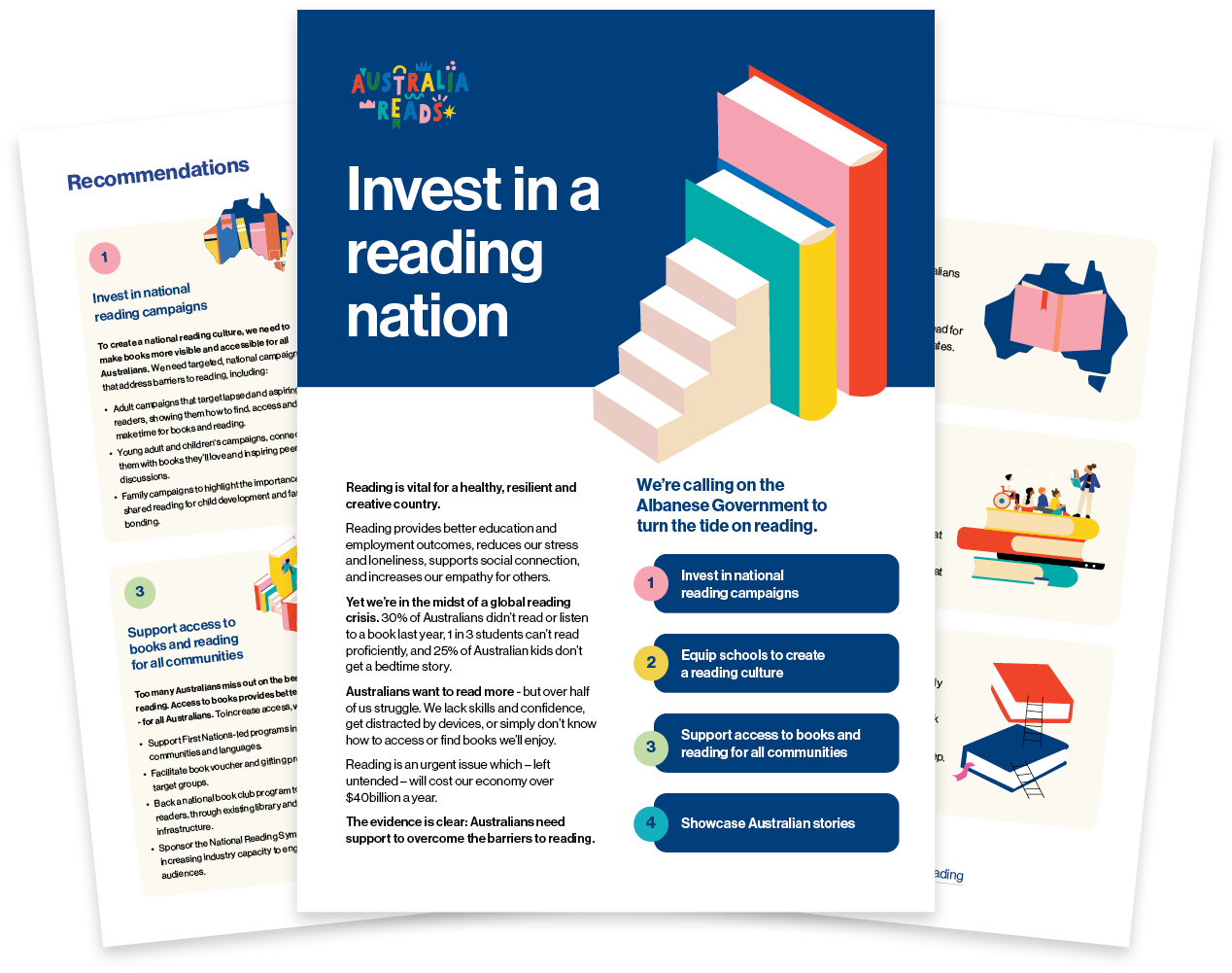
Invest in a reading nation
Download our key policy recommendations to increase recreational reading rates in Australia.
The benefits of recreational reading
Regular reading for pleasure…
- Improves our physical and mental health
Regular reading for pleasure is proven to reduce stress by up to 20%, and lowers the risk of mental health conditions like depression and anxiety. It slows our heart rate, helps us get a better night’s sleep – and readers even live longer! - Makes us more tolerant and empathetic
Reading helps us understand ourselves and the world around us, with readers being 57% more likely to have a greater awareness of other cultures, and two-thirds of readers reporting strong empathy - Reduces loneliness and builds connection
Research shows that adults who read regularly are less likely to feel lonely, and shared reading can provide an important bonding experience for parents, children and caregivers. - Improves our long term educational and economic prospects
People who read for pleasure are more likely to have higher literacy levels, which has important flow-on effects for education, employment and wellbeing. - Strengthens our democracy
Proficient reading skills empowers people to actively participate in their communities and political processes. High reading rates are seen globally as a sign of a healthy, democratic society.
The stats on reading
- Australians love reading, with over two thirds of the population (aged 15+) reading for pleasure – that’s 14.3 million Australians.1
- Australians want to read more – with around half of Australians (54.9% of Readers and 49.8% of Non-Readers) say they read less than they intend to.2
- 44% of Australians have low or very low literacy 3
- 1 in 3 Australian children can’t read proficiently 4
- 29% of secondary school students don’t read for pleasure 5 – rising to 52.6% in some states6
- Young men aged 15–24 are the least likely to read recreationally7
- 25% of Australian parents rarely or never read with their children8
The mix of low literacy levels and falling reading rates leads to poor social, educational, health and economic outcomes – for all ages.
Recommendations for change
Invest in national
reading campaigns
To create a national reading culture, we need to make books more visible and accessible for all Australians. We need targeted, national campaigns that address barriers to reading, including:
- Adult campaigns that target lapsed and aspiring readers, showing them how to find, access and make time for books and reading.
- Young adult and children’s campaigns, connecting them with books they’ll love and inspiring peer-led discussions.
- Family campaigns to highlight the importance of shared reading for child development and family bonding.

Equip schools to create a reading culture
Schools are a vital part of healthy reading communities. To support educators as they create lifelong readers, we need to:
- Mandate a library in every school, with qualified staff and collection funds.
- Support schools to build a love of reading in students, alongside skills development in the classroom.
- Provide schools with tools and resources to help parents create positive home reading environments.

Support access to
books and reading
for all communities
Too many Australians miss out on the benefits of reading. Access to books provides better outcomes – for all Australians. To increase access, we can:
- Support First Nations-led programs in Indigenous communities and languages.
- Facilitate book voucher and gifting programs for target groups.
- Back a national book club program to reach new readers, through existing library and bookshop infrastructure.
- Sponsor the National Reading Symposium, increasing industry capacity to engage new audiences.

Showcase
Australian stories
A healthy reading culture needs books that reflect our lives. To offer readers relevant Australian titles, we need to:
- Invest in data systems that increase visibility of Australian books.
- Fund an ‘Australian stories’ promotion with a strong focus on First Nations writers.
- Enable festivals and publishers to tour Australian authors regionally.
- Expand the LitUp program to deliver locally-led author events to all Australian schools.
- Research the impact of representation in Australian books.

- Creative Australia (2022) Creating Value: Results of the National Arts Participation Survey ↩︎
- Wright, B., Lennox, A. & Mata, F. (2025) Understanding Australian readers: Behavioural insights into recreational reading. ↩︎
- ABS (2013). Programme for the International Assessment of Adult Competencies, Australia,
↩︎ - Hunter, J., Stobart, A., and Haywood, A. (2023). The Reading Guarantee: How to give every child the best chance of success. Grattan Institute. ↩︎
- L. Rutherford, A. Singleton, B. Reddan, K. Johanson, M. Dezuanni (2024). Discovering a Good Read: Exploring Book Discovery and Reading for Pleasure Among Australian Teens. Geelong: Deakin University. ↩︎
- Zhou M, Maher C, Brinkman S, Cools J, Dumuid D. Postpandemic (2025). After-School Activities Among Youths in Australia. ↩︎
- ABS (2024). How Australian generations spent their time on recreation and leisure ↩︎
- Oxford Children’s Language Australia (202). Gift of Words 2021 ↩︎