

From picture books through to novels, books and reading form an important and enjoyable part of the daily lives for many Australian boys and men.
However, recent media coverage has prompted widespread discussions around the male ‘reading crisis’ in Australia, and how reading engagement may potentially differ between the genders.
So what’s the full story?
We look at the latest data around boys’ and mens’ engagement in reading, share some top tips for promoting a love of reading, and highlight some fantastic Australian programs and initiatives already making headway in this space.
What does the research tell us?
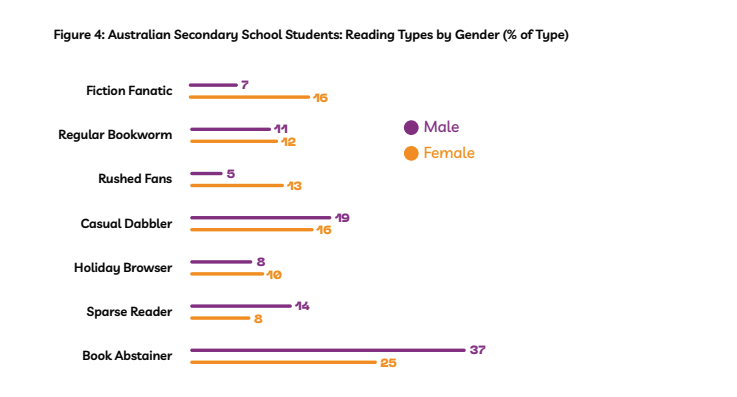
ABS data from 2021-22 tells us that Australian girls (77%) are more likely than boys (68%) to participate in recreational reading1, and that this trend continues into secondary school, with Deakin University research showing boys more likely to be ‘book abstainers’.2
In terms of reading ability, the Grattan Institute’s Reading Guarantee report shows that girls consistently perform better than boys in reading at school, and this gap widens in high school.3
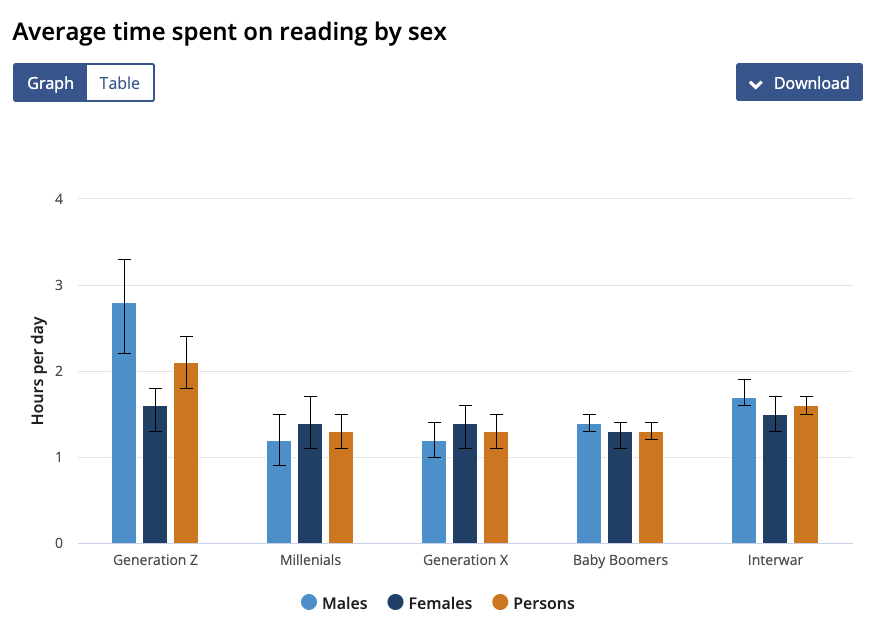
2024 ABS data shows men consistently reading less than women across generations, with young men aged 15–24 being the least likely to read recreationally in Australia.4
And when it comes to shared reading, women are more likely than men to read to someone else (32% compared to 25% of men).5
But is it that straightforward?
A global report from the National Institute for Education (NIE) argues that the view that boys read less than girls is overly simplistic, with “much of the complexity of the situation lost in surveys… making invisible the ways many boys do enjoy reading.”
The NIE report argues that other factors, such as socio-economic status and access to books may be just as – if not more – influential in shaping reading behaviours than gender.
As a recent article in The Conversation argues, these factors “shape children’s access to books, literacy and educational opportunities (like reading at home and attending preschool). They also shape the meaning we attach to reading.”
In looking at teen reading habits, researchers from Deakin University found that ‘reader personas’ that take into account reading preferences, frequency, and attitudes, rather than gender, is a more nuanced way of engaging with the issue, and finding targeted solutions.
From a reading engagement perspective, it’s also worth looking at the data around formats. Recent Creative Australia data shows us that women are more likely to read print books, with men more likely to read graphic novels or comics. Men are also more likely than women to read ebooks once a week or more often (27% compared to 24%), listen to audiobooks (27% compared to 21%) and read on online platforms (24% compared to 16%).6

What are the barriers?
From infancy through to adulthood, the ‘reading problem’ for all genders, including boys and men, has a range of environmental, social, and economic factors.
As The Conversation reports, “research confirms many boys enjoy reading, though they are less likely to admit it if they think it will affect their ability to fit in. And for decades, research has shown young people are socialised to see reading as a feminised activity, incompatible with dominant forms of masculinity.”
Limited, gendered ideas of what constitutes ‘boys books’ is also a major issue affecting reading engagement (ie. books about sports, war, science etc), which can result in a difficulty for some boys in finding and accessing books that meet their unique interests.
When it comes to adults, men are facing many of the same barriers as the population as a whole: a perceived lack of time, difficulties finding books they like, issues with confidence around reading, and more. It’s not just a men’s issue – it’s an everyone issue!
So, how can we support boys and men to read more?
- Let boys choose: Research shows that when children and young people choose their own reading material they are more likely to finish the book, and enjoy it. Allowing boys to choose their own reading material – in ways that align with their unique interests – is a great way to get them engaged in reading in a way that feels right for them.
- Don’t make assumptions: When teachers and caregivers make stereotypical assumptions about reading preferences by gender they potentially constrain young boys’engagement with reading. Be open-minded about boys’ potential as readers, and ensure they have the same opportunities as everyone to fall in love with reading.
- Challenge the idea of ‘boys books’: A reliance on outdated ideas of what makes a ‘boys book’ – i.e. books related to war, sports and world records – may stifle boys’ engagement with reading. Look for books that align with individuals interests, and encourage engagement with all kinds of stories, topics and formats.
- Make reading social: Reading doesn’t have to be a quiet, solitary activity. Provide opportunities for boys and men to read socially, connecting them to their peers and bringing books to life through conversation, selection and reading with others.
- Show relatable reading role models: From personal role models such as parents and teachers, to public role models such as sports and screen stars – it’s important for boys to see those that they respect and – most importantly – relate to valuing and enjoying reading.
- Don’t force it: Forcing reluctant readers to read against their will may create negative associations with reading that can last long into adulthood. However, don’t accept that just because someone doesn’t want to read at one stage of their life, that they might not enjoy it at another.
- Take reading out of ‘bookish’ spaces: For those who are already confident and comfortable readers, bookshops and libraries are an easy space to navigate. But for lapsed and non-readers, they may be unfamiliar or overwhelming. Take books and reading into non-literary spaces like pubs, gyms, public transport and community centres and to reach new readers.
What’s already happening in Australia?
Across Australia, there are a range of programs and initiatives successfully supporting boys and men’s reading.
The Tough Guy Book Club runs regular book club meet ups in pubs around Australia, and has recently expanded to run programs in high schools with young boys and teenagers.
Readalong programs with Dads operate in libraries across Australia, while bookstores like Ramona have been trialling a ‘Boys Reading to Boys’ event.
Further Reading:
- Boys, blokes and books: Engaging boys in reading (ACU)
- Disrupting the ‘Boys Don’t Read’ Discourse: Primary School Boys Who “Love” Reading Fiction (South Australian study)
- The National Institute of Education position paper: The Decline in Volitional Reading: Evidence-Informed Ways Forward
- How Tough Guy Bookclub is helping men reconnect with reading, via Channel 7
Citations
- ABS (2021-22), Cultural and creative activities ↩︎
- L. Rutherford, A. Singleton, B. Reddan, K. Johanson, M. Dezuanni (2024) Discovering a Good Read: Exploring Book Discovery and Reading for Pleasure Among Australian Teens, Deakin University ↩︎
- Hunter, J., Stobart, A., and Haywood, A. (2024). The Reading Guarantee: How to give every child the best chance of success. Grattan Institute. ↩︎
- ABS (2024). How Australian generations spent their time on recreation and leisure ↩︎
- Creative Australia 2026, Creative Transformations: Results of the National Arts Participation Survey. ↩︎
- Creative Australia 2026, Creative Transformations: Results of the National Arts Participation Survey. ↩︎