
The latest data from the Programme for International Student Assessment (PISA) shows Australian students’ reading scores have hit their lowest point on record.
Australian students’ performance in reading
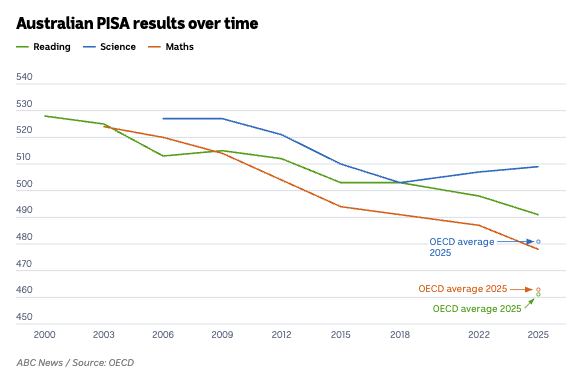
Between 2022 and 2025, Australia’s mean performance in reading declined, with a decrease in the proportion of students who attained the National Proficient Standard (NPS), and an increase in the proportion of low performers in reading.
According to the OECD, 20 points on a test score is roughly equivalent to one year of learning for the average student. That means, in reading, students last year were roughly two years behind where their peers were in 2000.
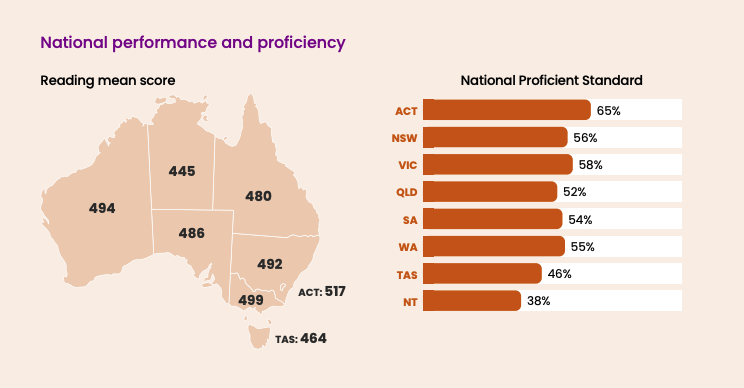
Students in the ACT had the highest reading mean score, followed by Victoria, Western Australia and New South Wales.
A global decline
Australia’s performance is part of a worldwide decline in teenagers’ reading skills.
Reading recorded the steepest drop of all subjects, with scores falling by 28 points across OECD countries and by 16 points among other countries and economies between 2015 and 2025.
According to the report, teenagers were losing the skills that “matter most in the age of AI”, such as being able to critically evaluate information from different sources. The share of “hasty readers”, who rush through texts to give quick, incorrect answers, has almost doubled between 2018 and 2025.
The report also showed that 46% of students in OECD countries use AI chatbots weekly or more to help them learn.
It also reported that over half of students may be vulnerable to misinformation and disinformation.
“In reading, increased digitalisation, longer screen time and falling rates of reading for enjoyment have coincided with weaker literacy outcomes. Countries with the largest declines in reading also tended to record the largest drops in mathematics and science.
This trend is particularly concerning because reading skills underpin learning across the curriculum and are essential for finding, evaluating, interpreting and reflecting on information in an increasingly digital world.”
– Mathias Cormann, OECD Secretary-General
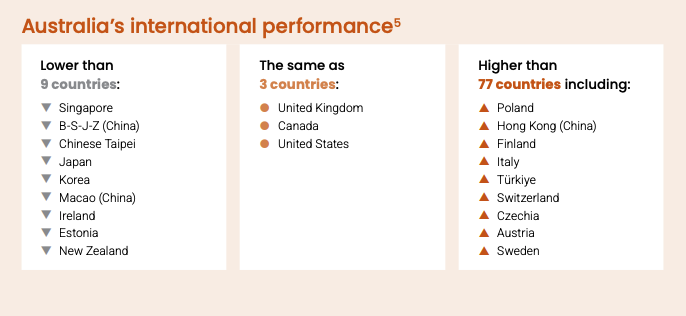
Despite Australia’s declining test performance, students’ performed above the OECD average on all testing areas, and were on par with the UK and US in reading scores.
What is PISA?
Run by the Organisation for Economic Cooperation and Development (OECD), PISA is an international comparative assessment that measures the knowledge and skills of 15-year-old students across science, reading and mathematics.
Rather than assessing how well students have mastered a particular curriculum, PISA focuses on their ability to apply what they have learned in school to real-world problems and situations
As part of the assessment, 766 Australian schools and 14,658 students took part, representing about 275,000 students.
Explore the full OECD PISA results, or download the report on Australia’s results.
What can we do?
These latest results shows the urgent need for support for reading in our schools.
To support educators as they create lifelong readers, we’re calling on the Government to:
- Mandate a library in every school, with qualified staff and collection funds.
- Provide schools with tools and resources to help parents create positive home reading environments.
- Support schools to build a love of reading in students, alongside skills development in the classroom.
Find out more about our policy recommendations, read our joint statement on reading for pleasure and school libraries, and support the current petition to mandate teacher-librarians in Australian schools.