
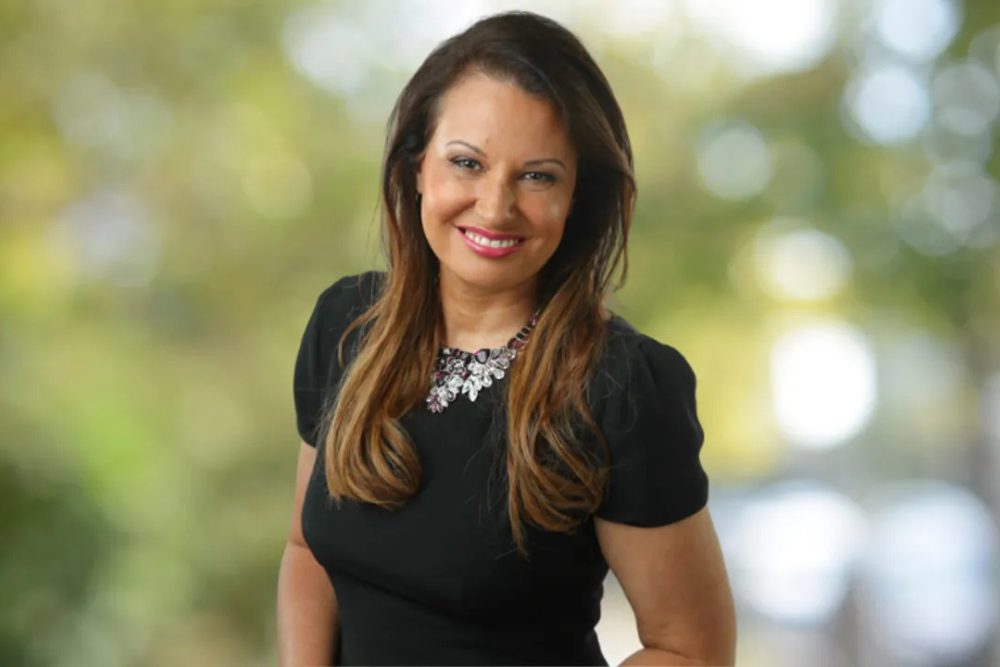
Read Distinguished Professor Larissa Behrendt AO’s powerful opening keynote, presented as part of ALIA’s 2026 National Conference.
Holding the National Story: Truth, Memory and Social Cohesion in a Fractured Age or Why Libraries Matter More than Ever.
– Distinguished Professor Larissa Behrendt AO
I would like to start by taking that important moment to acknowledge country, to reflect on how long it has been that story and culture has been rich on this land that we are gathering on. And as we do that, we can give our thanks to the Elders who have kept story and culture strong. It is also our chance to reflect on what role we can play in continuing that legacy as we contribute to a sector that is so crucial to on-going story and culture in this country.
And I would like to take this opportunity to thank Professor Kirsten Thorpe, my colleague at UTS who leads our Indigenous Archives and Data Stewardship Hub, to Wenona Byrne, the Director of Writing Australia, and to Alison Delitt, our newly appointed Director-General at the National Library of Australia – an appointment that board has been absolutely delighted with and excited by – three amazing women who have given me such valuable feedback on my thoughts for today.
I would also like to take this moment to acknowledge Marie-Louise Ayers who, as you know, recently retired from the National Library. I want to note, amongst so many of her colleagues here today, her extraordinary contribution and her leadership. Marie-Louise has been a deeply thoughtful custodian of one of our nation’s great cultural institutions, guiding the Library through enormous technological, cultural and social change while holding firm to its core purpose: preserving knowledge, expanding access and ensuring Australians can see themselves, and each other, in the national story.
***
I grew up in a house where, no matter what we didn’t have, books were the most prized treasure. We didn’t have much spare money. But we had shelves of paperbacks, encyclopaedias, dog-eared novels, and we borrowed library treasures that moved in and out of the house like visiting relatives.
Mum had wanted to go to university, but her father insisted on secretarial school, so she ran away and joined the Women’s Royal Australian Navy (or the WRANS) and worked in intelligence there until she was forced to leave when she married my father – as was the public service rule at the time. For Mum, education was the thing that transformed your life. So not surprisingly, she taught me to read early. She saw it as foundational.
My father was a voracious reader. Books were his way of arguing, imagining and learning beyond the limits that had been placed on him. As an Aboriginal child sent to an orphanage, he had to leave school at the age of fourteen. But during his formal education he had been deeply, negatively affected by the way history was taught and he recalled shrinking as Aboriginal people were described as savage and as attempting stop white people from expanding the colony. So, as an adult, he read with great interest the history that was being written to counter W. E. H. Stanner’s ‘Great Australian Silence.’ Henry Reynolds, Peter Read, Ann Curthoys, Ann McGrath were amongst the books that changed not only his understanding of history but how he saw himself.
In my later years of secondary school, my mother worked at the Sutherland Shire Council. I would spend my afternoons – and much of my school holidays – in the Sutherland Shire local library. I never remember a moment of being bored. I wandered the shelves, making lists of the books I wanted to read, discovering writers I had never heard of, and feeling the quiet thrill of being trusted with the world’s knowledge.
I grew up understanding that reading was not just leisure. There was real power in it.
That library was a sanctuary. It was pathways to another world. It was a place where I found my place and, in many ways, found my voice. And I grew up understanding that reading was not just leisure. There was real power in it.
A Place for Every Story
Now, when I walk into the National Library of Australia, I feel something deeper than admiration. I feel connection. And it is not just because the library space is one where I have always felt safe and seen.
My own papers are held there. The oral histories of the Stolen Generations held there contain the storytelling of people I know, voices that carry both pain and resilience.
There is an oral history of Norfolk Island – a place where I spent part of my childhood and to which I return every year – its layered past preserved and accessible.
There are articles about Yuwaalaraay culture and language in Trove that have helped in the regeneration of our language and revitalised our cultural knowledge.
There is the recent digitisation of the WRANS newsletters of which my mother was proudly a part.
In one institution, I can trace threads of my family, my community, my culture and my professional life. The national story and the personal story intersect on those shelves and in those databases.
That is the work of careful stewardship. And it is a long way from where the GLAM sector was when I was growing up. At that time, these institutions often collected our stories without our consent. They interpreted us without our involvement. They classified and described us through a colonial lens.
The shift toward collaboration, accountability and First Nations leadership has not been cosmetic, it has been structural.
When institutions hold our stories with care, trust grows. Belonging deepens. And social cohesion becomes possible – not because we pretend our histories are simple, but because we are prepared to hold their complexity together.
When institutions hold our stories with care, trust grows. Belonging deepens. And social cohesion becomes possible…
When I think about the libraries that shaped me – from the local library at Sutherland where I spent those long afternoons as a child and a teenager, to the solace I found in the libraries at school and university, to the National Library of Australia where fragments of my own life now sit in collections, I don’t think first about buildings.
I think about what they made possible. They made knowledge accessible. They made stories durable. They made curiosity legitimate. They made connection tangible.
And I think about the people who are dedicated to ensuring that space is as magical, transformative, important and resonant as it is.
And if we needed further proof of how dedicated, committed and revolutionary our librarians are, look to the Daraya Underground Library in Syria, established by young students and activist between 2012 and 2016 when Daraya, on the outskirts of Damascus, was under siege. They rescued books from the rubble of buildings and abandoned homes and salvaged – and catalogued – over 15 000 books, writing the owners name on them to ensure they could be returned. This story shows not just how important knowledge and imagination is when our society is in crisis, it highlights how libraries can be an important form of resistance.
Libraries as Spaces of Hope
Because libraries are a source of hope.
Now, I don’t expect you to simply nod along. Many of you are working under pressure – budget constraints, staffing challenges, digital disruption, rising demand. Hope may not be the first word that comes to mind at the end of a long week.
So let me make the case.
We are living in a moment where truth feels contested. Where misinformation travels faster than correction. Where public trust in institutions is brittle. Where algorithms fragment our attention and polarisation fractures our shared narrative.
In that environment, hope is not a soft idea. It is a structural one.
And libraries, I would argue, are part of that structure.
Because in that context where public trust is fragile and the national story is under strain, the work libraries do is civic. And civic work is hopeful work.
In [the] context where public trust is fragile and the national story is under strain, the work libraries do is civic. And civic work is hopeful work.
Truth matters. And so does the on-going development of our capacity for critical thinking. And nowhere do we better develop that ability to critically think than through reading and storytelling.
As a novelist, filmmaker and researcher, I have observed the many ways that story is power. It can liberate the person whose story had previously been suppressed or silenced. It can be a path to more deeply understanding someone else’s perspective and experience. But these stories can be contested.
As a First Nations person, I am acutely aware of how stories can also be dangerous and political. Think of how my father felt when taught a one-sided version of Australian history.
In my book, Finding Eliza: Power and Colonial Storytelling, I explore the way in which a narrative about a white woman shipwrecked off the coast of Queensland and claiming to have been captured by cannibals, was used to facilitate the brutal and violent dispossession of the Butchulla people. I looked at the oral history of the Butchulla side by side with the claims of Eliza Fraser, whose own account was held in the National Library. The Butchulla’s recollections give us a powerful counter-narrative to Eliza’s and allow us to write their perspective back into a history that they had been deliberately written out of.
Stories allow us to cross cultures. To restore dignity. To find a deeper, more nuanced, inclusive idea of the truth.
Our stories are national narratives. They help shape who we are, what are values are, how we see ourselves. These are the stories that we tell the world about who we are.
Whoever frames that narrative gets to direct what kind of nation we are.
And for this reason, these national narratives are contested but the best place for that contest to take place is not through divisive politics but through the exchange of stories that will create greater empathy.
Stories allow us to cross cultures. To restore dignity. To find a deeper, more nuanced, inclusive idea of the truth.
As Chair of Writing Australia, I think about who gets to create those stories.
As Chair of the National Library, I think about who stewards the collection, protection and access to them.
Different roles. Same question: How do we shape the story of a nation?
Stories help us to counter colonial narratives – the narratives of colonisation. In this way storytelling is an act of decolonisation. It is an act of revolution.
As a storyteller, you construct narrative ethically. You choose whose voice speaks. You decide where the camera lingers. You contextualise. You verify. You take responsibility.
Libraries do the same thing. They don’t simply store books. They decide how they are described, contextualised and made discoverable. They determine whether marginalised voices remain footnotes or become central texts. That’s cultural power.
And this is where social cohesion comes in.
In an age of misinformation, libraries are stablisers. And, crucially, libraries remain among the most trusted public institutions. This trust has been earned through professional ethics, stewardship and care.
In an age of misinformation, libraries are stablisers.
Libraries provide safe shared space across difference. They model pluralism. They facilitate and support lifelong learning. They foster curiosity. They support literacy which underpins democratic participation. And they offer belonging without ideological precondition.
Let’s take one example of how the National Library has undertaken this role in practice. The Bringing them Home oral history project was an exemplar of libraries as engines of change and the creation of new futures through past acknowledgment. It allowed for important voices to be a part of the national narrative, voices that had been long silenced. And we those experiences in someone’s own words.
The groundwork of this project took place in a climate where there were intense politics around the use of the term ‘stolen generations.’ To undertake this project at that time was an act of courage – and if the project had been delayed until a more favourable climate, many important voices would not have been captured.
Similarly, through Trove we can see the profound impact of newspaper digitisation on public understanding of the Frontier Wars. Researchers such as the late Lyndall Ryan drew on these archives to trace the evidence base for massacres and frontier violence, bringing together dispersed historical records to challenge long-standing silences in the national story.
In a divided society, libraries are quietly radical. They show people how to disagree without dehumanising. They don’t tell you what to think; they encourage you to think deeply. They insist on verification. They preserve complexity and hold nuance. They protect plural voices.
Libraries are one of the few institutions whose core ethic is authentication, stewardship, and access.
A National Cultural Policy
As the cultural sector faces many challenges, we have been lucky to have the importance of culture elevated through a national cultural policy – Revive: a place for every story, a story for every place. The policy set out an agenda for the Arts and Creative Industries in 2023 for the subsequent five years. We are living through the longest period where Australia has been guided by a formal cultural policy, and we are now entering the consultation process for the next iteration, the only time in our history we will have had one policy lead into another.
With its pillars of First Nations First, A Place for Every Story, Centrality of the Artist, Strong Cultural Infrastructure, and Engaging the Audience, this policy has been impactful, and I want to look at two areas where I think this so – both of which are close to my heart.
First Nations First
The pillar of First Nations First took Indigenous creativity and culture from the margins to the centre. And while this is also about implementation and programs, I want to take a moment to reflect on how important this is as an idea, as a statement of principle, as a positioning. Beyond greater investment in this area and attempts to ensure greater First Nations involvement in decision-making processes about resourcing, this is a value statement about who we are as a nation.
And what it has meant in practice is also a greater focus and centring of the significant place First Nations cultures play in the national identity, the national story, the values our society embraces and the story we tell the world about ourselves.
And it has challenged us as a sector.
Indigenous Cultural Intellectual Property
It has coincided with the important work being done to not only decolonise archives by ensuring a diversity of views and perspectives, but it has also been, through the work led by First Nations people in the GLAM sector, coming to terms with what it actually means to protect, honour and respect Indigenous Cultural Intellectual Property (ICIP).
This has forced us to answer important questions about authorship, ownership, attribution, veracity, perspective and standpoint, description and permissions. It has meant thinking about forms of repatriation, and protocols about use.
And this has not been easy. There are the challenges of the time and resourcing needed to engage communities around the country with the Indigenous cultural material contained in collections.
And there has been the push back from sectors of the community, in particular, the academic community, who are used to material being in the public domain and challenge the idea that there should be permissions or consultation needed for use.
But the development of ICIP protocols and practice has been a space where sector leadership has been vital.
And for all those challenges, there are benefits beyond the fact that it is the right thing to do. It has meant that material has been repatriated to the community – material that contains cultural knowledge and language. It has strengthened the relationship between the sector and the Indigenous community turning it from one of extraction to one of collaboration. It has helped to demystify these imposing buildings often with colonial facades as spaces that have a welcoming place for First Nations people, our stories and our knowledge.
I have seen from my role as Trustee of the Australian Museum how these challenges are shared by this part of the GLAM ecology. Museums hold objects that carry cultural meaning sometime with questionable provenance. Frameworks of ICIP have started an evolution from colonial collecting to collaborative custodianship. It has seen institutions acknowledge historical harm and undertake roles of repatriation, and it has engaged with the importance of First Nations leadership in shaping interpretation.
This mirrors what libraries are doing in archival practice. And I want to acknowledge Rebecca Bateman’s leadership in this space at the National Library.
This is hard work – and it is work that will take a long time. But it is crucial to undoing the damage that has been done by the appropriation of knowledge and culture – and its misuse – in the past. And it is a concrete step to a more inclusive, rich and vibrant sense of who we are.
The National Library recently opened its exhibition – Wanka Wakanutja – which traces the decades long work of the Papunya Literature Centre to record language and keep culture strong. This was a wonderful example of what can be achieved in this space but what was most special about it to me was to see members of the Papunya community walk into the library, to see themselves there, to feel comfortable and welcomed and to know that they had a place inside one of our most important national cultural institutions.
And, in an example of how the archives help to rebuild culture in practical ways, they are being used to support restoration of traditional burning, based on the work of National Library Fellow Stephanie Lee, who used historic aerial photographs to identify fire scars across four ranger groups in Western Australia. This research and awakening of knowledge is now being used to reinstate cultural burning.
The work in this space has seen our institutions moving from simply collecting to collaboration, moving from posturing a position of authority to relationships of partnership and moving from a practice of extraction to one of accountability.
This transformation strengthens social cohesion because it builds trust.
A Place for Books and Writing
Another place where the National Cultural Policy has made a difference that relates to the GLAM sector is of course the creation of Writing Australia.
This was part of a recognition of the fragility of this part of the ecology and the challenge posed to the sector as a result of the rise of engagement with social media, the challenges of generative AI, a drop in the rates of reading, of the pressures on publishers and small book stores, and the low remuneration many writers receive for their work.
Writers are often the first to disturb silence. They challenge official histories, they fill in gaps in the archive, they humanise statistics, they translate law and policy into lived experiences, expose what is unjust, and imagine alternative futures. And critically, writers contribute to social cohesion by deepening understanding.
Social cohesion is not the absence of disagreement. It is the presence of a shared narrative. Let me say that again: social cohesion is not the absence of disagreement. It is the presence of a shared narrative.
Social cohesion is not the absence of disagreement. It is the presence of a shared narrative.
Writers create that shared space. Libraries preserve it – so readers can inhabit it. And in that inhabiting, empathy grows.
Writing Australia has seen an increase of over $8 million into the writing ecology from support to publishers, and increasing funding and awards for writers, support for literary festivals, and strategies that support and promote writing and reading, strategies for getting books into the hands of readers including through schools and libraries. This also includes the establishment of a Poet Laureate to bring more attention to this important, much loved, but poorly paid, area of creative writing and expression.
And to take just one example of the important role our sector can play in finding spaces for stories and ensuring they are not forgotten, the National Library of Australia is undertaking a major project digitising the archives of twenty Australian women writers, including well know figures like Judith Wright and Jennie Scott Griffiths but also including lesser known figures, preserving not only their published work, but handwritten notes, letters, diaries and fragments of lives that shaped our national story. This builds on the National Library’s previous work to digitise the collections of women leaders – including the papers of trailblazing women like Bessie Rieschbieth, Ruby Rich, Dorothy Tangney, Enid Lyons, and Lowitja O’Donoghue – all of which are now online.
It is a reminder that libraries are not simply places that store books. They are places that protect memory, rescue voices from obscurity, and ensure future generations can encounter the people, ideas, movements – and women – that helped change this country.
An Opportunity for Advocacy
The next iteration of the National Cultural Policy is a chance for us through our sectors, our institutions and even in our personal capacity to continue to advocate for the things that will ensure the vibrancy and centrality of our culture and cultural institutions.
And first I would encourage you to not just reflect on the mechanics but to show support for the general direction – the pillars themselves – as ideas and values: First Nations First, A Place for Every Story, Centrality of the Artist, Strong Cultural Infrastructure, and Engaging the Audience.
These pillars are statements about the kind of cultural nation we are choosing to be. ‘First Nations First’ is a commitment to truth and to the rightful ordering of story and authority. ‘A Place for Every Story’ insists that our national narrative is shared, not singular, and that dignity lies in being heard. ‘The Centrality of the Artist’ recognises that creativity is how we make meaning, challenge power, and imagine futures. ‘Strong Cultural Infrastructure’ acknowledges that culture does not sustain itself. It requires investment, stewardship and long-term thinking. And ‘Engaging the Audience’ reminds us that culture only lives when it is encountered, when it reaches people where they are, and when it invites them into the story.
Taken together, these pillars articulate a vision of culture as civic, relational and essential.
But beyond the aspirations, I want to flag two areas that we need to continue to focus on.
From Principle to Practice: Resourcing First Nations First
As we look to the next iteration of ‘First Nations First’, the challenge before us is not just in how we support the principle. It is whether we are prepared to properly resource it. Because without that, it risks becoming symbolic rather than structural.
Implementing Indigenous Cultural Intellectual Property protocols is not a matter of drafting guidelines and expecting compliance. It requires time, relationship-building and trust. It means consulting with communities across the country, often multiple communities connected to a single collection item, each with their own authority structures, protocols and expectations. It is the cost of compensating knowledge holders for their expertise and authority. And the cost of redesigning systems so that they can hold cultural permissions, restrictions and context.
That work cannot be rushed, and it cannot be done without investment.
And critically, it requires investment in people.
If we are serious about First Nations First, then First Nations leadership within our institutions cannot be peripheral or precarious. It must be embedded, supported and sustained. That means creating pathways for First Nations employment at all levels of the sector, from entry-level roles to senior leadership. It means investing in training, mentorship and capacity-building so that institutions are not simply consulting communities but are shaped by them from within.
If we are serious about First Nations First, then First Nations leadership within our institutions cannot be peripheral or precarious.
I would note that there is already enormous expertise and leadership within the sector – but it needs to be supported and empowered. First Nations people who have come into the sector often find themselves asking fundamental questions which can be confronting and as a result can get labelled as ‘difficult.’ They lead enormous change across their institutions, particularly in the ICIP and community engagement spaces, even though they are often in junior roles. Part of the strategy needs to be in better supporting the expertise that already sits within the sector.
I would also like to point to the work done by Professor Kirsten Thorpe and her team which has acknowledge the need for, and sought strategies to support, the whole sector in becoming more skilled in this space. Her article, co-written with Lauren Booker, off the back of running a national dialogue session on Indigenous priorities in libraries at the end of 2024, has just been published in the Australian Library Journal. It is focused on how to bring the discipline of Indigenous Librarianship to Australia, not just to grow Indigenous employment in libraries, but to give people across the sector the skills and knowledge to work in Indigenous contexts.
Kirsten’s team has also worked with ALIA to develop the Respect and Recognition of Aboriginal and Torres Strait Islander Peoples, Cultures and Countries in Australian Libraries, an online course which was launched at the end of last year to build foundational knowledge. This can be seen as a first step for libraries building their capacity. A first step, but an important start.
ICIP is a cultural shift. It asks institutions to move from control to consent, from ownership to custodianship, from extraction to relationship. And that kind of transformation requires resourcing, commitment and accountability over the long term.
But if we get this right, the benefits are profound.
Collections become richer, more accurate and more meaningful. Relationships with communities deepen. And institutions become places where First Nations people see themselves not just reflected but respected and empowered.
A Nation of Readers
If we are serious about the pillars of the cultural policy – about engaging audiences, about placing the artist at the centre, about making space for every story – then we have to confront a simple truth. None of it works if people are not reading.
We are seeing a steady erosion in reading engagement, particularly long-form reading. Attention is being pulled elsewhere, into faster, louder, more fragmented spaces. And while those spaces have their place, they do not replace what reading does.
Reading builds attention. It builds empathy. It builds the capacity to sit with complexity, to follow an argument, to encounter a perspective that is not your own and stay with it long enough to understand it.
Reading builds attention. It builds empathy. It builds the capacity to sit with complexity, to follow an argument, to encounter a perspective that is not your own and stay with it long enough to understand it.
The recent Grattan Institute report noted of every twenty-four students in a class, eight can’t read. It also noted that students who struggle with reading are more likely to fall behind, be disruptive and drop of school. They are more likely to be unemployed or in poorly paid jobs. It was an important reminder of the link between reading and economic well-being.
If libraries are the custodians of knowledge, then readers are the citizens of that knowledge. And right now, we need to grow that citizenry.
That is why I see the need for a coordinated, properly resourced national reading program, one that supports and expands the work already being done through organisations like Australia Reads.
This is not about a campaign in the traditional sense.
It is about cultural infrastructure. It is about meeting people where they are – through schools, libraries, community organisations, workplaces and digital platforms – and creating pathways back into reading. It is about supporting librarians as frontline cultural workers in that effort. It is about ensuring that books are not only available, but visible, relevant and actively shared.
It is about recognising that reading is not a private pastime. It is a public good.
A national reading program would strengthen the entire cultural ecology. It supports writers by building audiences. It supports publishers and booksellers by sustaining demand. It supports libraries by deepening engagement. And most importantly, it supports social cohesion by creating a shared space where ideas, stories and perspectives can be encountered with depth and with care.
A national reading program would strengthen the entire cultural ecology.
In a time of fragmentation, reading is one of the few acts that asks us to slow down, to listen, and to imagine beyond ourselves. If we want a society that can hold complexity, that can engage in good faith, that can sustain a shared narrative across difference, then we have to invest in the habits that make that possible.
Reading is one of those habits.
A nation that stops reading is a nation that loses the ability to understand itself.
Truth and Democracy
Writers create narrative possibility; libraries protect narrative continuity. Together they shape society by ensuring that people can encounter not only knowledge, but one another.
In every library there is someone discovering a voice that sounds like theirs for the first time. Someone learning that their history matters. Someone finding language for grief, for curiosity, for resistance, for hope. Someone realising they are not alone.
That is why libraries are at the heart of our society, and why so many of us have so much affection for them.
In an age of noise, they defend attention. In an age of misinformation, they defend evidence. In an age of division, they defend our capacity to imagine ourselves connected to one another.
And perhaps that is their most important role of all.
Because social cohesion is not built through slogans or enforced agreement. It is built when people feel that they have a place in the national story. Social cohesion is not the absence of disagreement. It is the presence of a shared narrative.
Social cohesion is not built through slogans or enforced agreement. It is built when people feel that they have a place in the national story.
Libraries make that possible.
They preserve memory. They protect truth. They hold complexity with care. They keep stories alive long enough for a society to learn from them.
In a fractured age, that is not peripheral work. It is nation-shaping work.
And those who do it are not background custodians.
They are the stewards of our collective memory, our civic imagination and, ultimately, our shared future.
Distinguished Professor Larissa Behrendt AO is a Eualayai/Gamillaroi woman and Laureate Fellow at the Jumbunna Institute of Indigenous Education and Research at the University of Technology, Sydney. She is a graduate of the UNSW Law School and has a Masters and SJD from Harvard Law School. She has published numerous textbooks on Indigenous legal issues.
Larissa won the 2002 David Uniapon Award and a 2005 Commonwealth Writer’s Prize for her novel Home. Her second novel, Legacy, won a Victorian Premiers Literary Award. Her most recent novel, After Story (2021, UQP) won the 2022 Voss Literary prize. Larissa is also an award-winning filmmaker. She won the 2018 Australian Directors Guild Award for best Direction of a Documentary Film for After the Apology and the 2020 AACTA for Best Direction in Factual Television for her documentary, Maralinga Tjarutja.
She is a Trustee of the Australian Museum, a Director of Sydney Dance Company, Chair of the Community Spirit Foundation, Chair of the Writing Australia Council and Chair of the National Library of Australia. She was awarded an Order of Australia (AO) for her work in Indigenous education, the law and the arts in 2020. Larissa received the Human Rights Medal 2021 from the Australian Human Rights Commission. She is the host of Speaking Out on ABC Radio.
First presented at ALIA National Conference in May 2026; reproduced with kind permission of Prof. Behrendt AO.