

When Australians are asked about our reading habits, many of us report ‘not having the time.’ But what does this really mean? And how can we help people make more time for reading?
Australians want to read more – with 54.9% of Readers and 49.8% of Non-Readers indicating they read less than they intend to, according to our recent report.
When asked about what stops them from reading, however, time seems to be a sticky issue.
37% of Australian adults say they do not read because it is difficult to find the time1, while Deakin University’s report into Aussie teens’ reading habits revealed ‘a lack of free time’ as the second highest barrier to reading.2
‘Not having the time to read’ is a refrain we hear time and again in our industry, and is a growing problem as our lives (and schedules) seem increasingly busy.
We unpack what’s behind the idea of time as a barrier to reading, and how we might use positive approaches to help people fit reading into daily life. Read our full break-down or jump to our key takeaways!
It’s not about the time, but how we prioritise it
Some good news: Reading is the fourth most common leisure activity for Australians according to our recent study.
However, there’s no doubt that reading has a lot of competition for our time – from school, work and family duties, to other forms of leisure like sport, TV and gaming.
Behavioural scientist Dr Breanna Wright says that when it comes to reading (or not reading) it’s “less about not having the time, and more about how you perceive your leisure time and prioritise the time you have”.
Despite general increases in the overall amount of leisure time people have, there is a perception that leisure time is scarce, partly because our leisure time is often fragmented.
As an industry, we need to promote reading as an enjoyable and, importantly, fun leisure activity, worth prioritising in busy schedules.
It’s not just about the ‘reading’ part
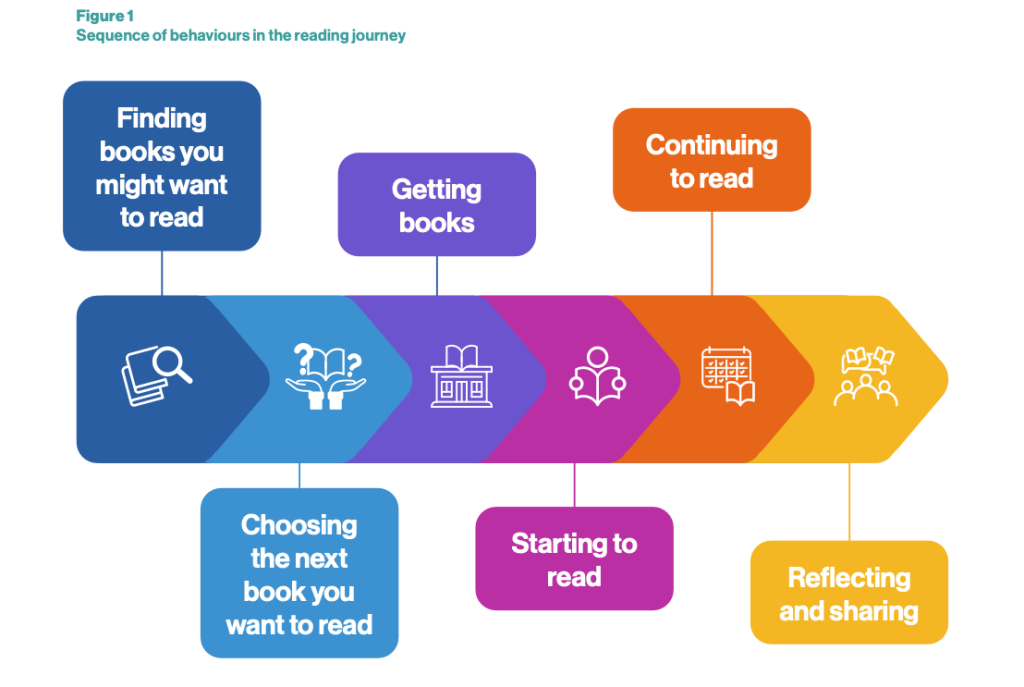
Reading is not a single act. It’s a series of behaviours – from finding a book to read, to getting that book from a library or bookshop, to actually reading the book itself.
For many infrequent readers, book browsing is not an activity they enjoy or engage with. There’s a problem here: you can’t read a book you haven’t found, right?
By encouraging people to make time for other steps on the reading journey (and making it as easy as possible for them to engage with these steps), we may ‘unlock’ time for reading.
Identity and confidence play an important role
For some, ‘not having time to read’ may be a phrase that covers up deeper issues around confidence and trust in reading ability.
Our perceived ‘ability’ in an activity (ie. how confident we feel about it) is another key driver of participation.
How we identify or see ourselves plays a significant role in how we spend our time. So, perhaps unsurprisingly, those who identify as a ‘reader’ are more likely to carve out the time to read. And those who do not feel confident describing themselves as ‘a reader’ – even if they do read! – are less likely to make time.
The question for our industry then becomes: how can we give more people more confidence to see themselves as ‘a reader’?
Implementing messaging that reinforces that “anyone can be a reader” and that “all reading is good reading” regardless of content or difficulty, may help lower the barriers to reading.
Likewise, normalising that it’s okay to go through different periods of reading and not reading depending on busy life stages, and that it’s never too late to get back into the habit.
Audio and shorter books can reduce barriers to entry
When considering reading, many people will envision needing a quiet place and extended period of time to sit down with a physical book.
But there are a range of adaptable ways that people can integrate reading into their daily lives.
Promoting audiobooks as an easy and accessible way to listen to books on-the-go – whether while commuting to work, walking the dog, or going to the gym – may make it easier for people to imagine fitting reading into their individual schedules.
Likewise, showcasing shorter books or ‘easy reads’ may also help reduce the perceived effort of reading and boost a sense of accomplishment from finishing books.
Practical time management and goal-setting strategies are useful for some
Perception of our leisure time is one thing, but how we manage it is another.
Our recent research indicates that many infrequent or aspiring readers would benefit from practical help to make the time for it.
This might include providing access to resources or tools that can help enhance focus during reading sessions: for instance, encouraging people to put their phone on silent or in another room, or setting phone reminders to read for pleasure.
Similarly, we can help people set personalised goals that work within their daily routines: for example, “If I take the train to work, then I will read a book on my commute,” or, “I’ll aim to read for half an hour before bed.”
For parents and educators, this may mean carving out time in children’s and teenager’s schedules for reading.
Ultimately, we need to work with people to create personalised reading schedules or routines, factoring in their current commitments, to make integrating reading into their day-to-day lives as easy as possible.
Friendlier reading environments can boost engagement
The way our environments are structured around us can influence the ways we interact with, and prioritise reading.
Encourage aspiring readers to make small adjustments to create more conducive reading environments or routines. This could involve keeping books in visible spots, creating a designated reading area in the home or workplace, or keeping a book in your work bag. These small changes can prompt reflection about how people want to spend their time.
In libraries, Singaporean research has shown how much physical space can affect the time we make for reading. Simply by shifting the lighting, the sound, even the way the furniture is positioned, can encourage either conversation, or quiet time with a book.
Key takeaways: Reframing reading time
- Focus on positive messaging – rather than focusing on the ‘reading problem’, or pitting reading against other competing forms of leisure activities, emphasise the joys of reading to make people want to prioritise it in their busy schedules.
- Highlight that consciously making time for reading can help embed the habit.
- Showcase shorter books and ‘easy reads’ as a way to make reading more approachable and feel a sense of accomplishment at finishing books.
- Reinforce the message that “anyone can be a reader” and that “all reading counts” – this may help people identify more as ‘a reader’ (and make more time for it!)
- Encourage alternative formats like audiobooks and ebooks to help people fit reading into their busy lives.
- Support people to make time for book browsing and discovery – this may help ‘unlock’ the act of reading as a later step on the reading journey.
- Show people how to make small adjustments to their homes, workplaces or schools to create more conducive reading environments or routines.
Explore the Executive Summary and full findings of the Understanding Australian readers report.
- Australia Council for the Arts, Widening the Lens: Social inequality and arts participation, 2023 ↩︎
- Rutherford, L. & Johansen, K. et. al. Teen Reading in the Digital Era: Platforms, Access and Diversity, Snapshot Report of the Teen Reading Pilot Study, March 2017 ↩︎