
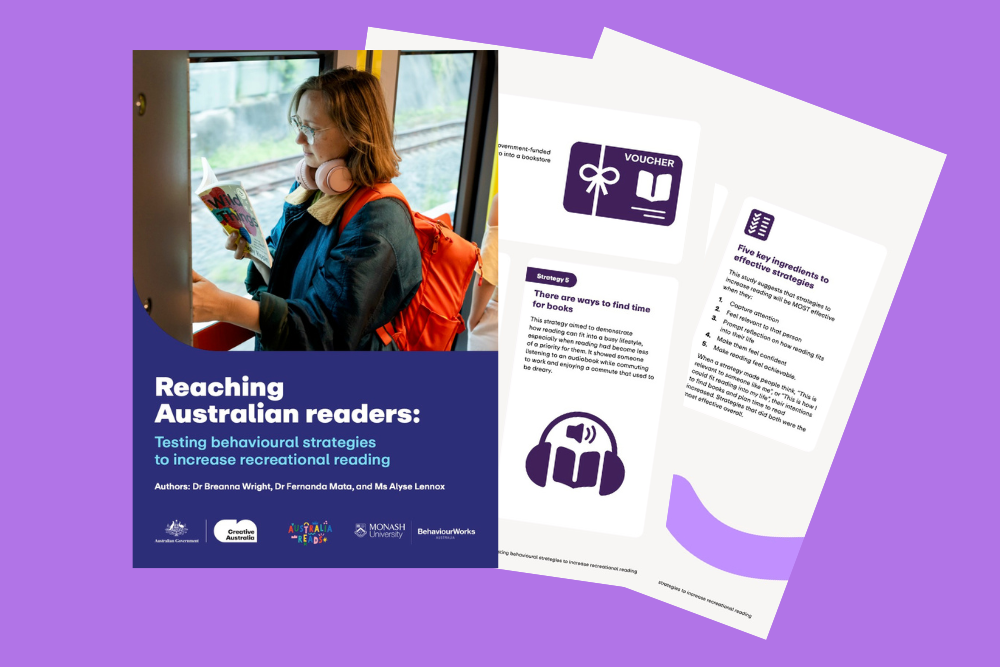
What are the most effective strategies for getting more Australians reading? The newly released Reaching Australian readers report offers insights and takeaways for the industry.
New national research from Monash University, in collaboration with Creative Australia and Australia Reads, delivers a roadmap to help Australians read more often, translating behavioural science into actionable recommendations for the books and publishing industry.
The report builds on the findings from the Understanding Australian readers report (2025), which identified the drivers and barriers to recreational reading and identified four priority segments for the industry to target: Engaged, Ambivalent, Aspirational and Lapsed readers.
This new project takes the research a step further by testing strategies on these priority segments to discover which will be most effective at shifting the reading intentions of Australians.
Reaching Australian readers offers valuable insights for publishers, booksellers, librarians and the broader literary industry on what messages and mechanisms are most likely to get Australians reading more.
Lead researcher Dr Breanna Wright said the findings highlight the importance of strategies that feel personally relevant, prompt reflection and promote easy, low-effort approaches.
“Our research shows that strategies work best when people can see themselves in the message, feel confident they can do it, and believe reading can fit into their lives in small, manageable ways.”
– Dr Breanna Wright, BehaviourWorks Australia
Over the coming months, Australia Reads will be using these findings to make recommendations both to industry and to Government on effective national strategies for shifting reading rates.
Explore our key takeaways from the report below, or read the full report.
5 key ingredients to effective strategies
The report suggests that strategies to increase reading amongst Australians will be most effective when they:
- Capture attention
- Feel relevant to that person
- Prompt reflection on how reading fits in their life
- Make them feel confident about finding and reading books
- Make reading feel achievable
Practical, low-effort tactics resonate
“People respond most to clear and concrete steps; how to use library apps; how to discover books that match their interests; how to use pockets of time to meet reading goals,” says Dr Breanna Wright.
People are far more likely to engage in behaviours that feel effortless. Strategies that reduce friction, such as curated recommendations aligned to personal interests, or simple tools that help readers intentionally integrate reading into daily routines, tended to be more effective.
Remember: what feels ‘simple’ or ‘easy’ for an Avid Reader is very different to a Lapsed or Aspirational – so sense check your messaging on these priority groups.
Make reading feel personal and relevant
The more that a strategy made someone consider how reading fit into their life and felt relevant to someone like them, the more effective it was.
Strategies were most effective when they helped people see themselves in the message and recognise how reading could realistically fit into their own routines.
When messages prompted reflection on “how this could work for me”, both intentions to find and read books increased. Strategies that achieved both relevance and practical resonance produced the strongest overall impact.
Confidence is key
The more a strategy made people feel confident to read and made reading feel achievable in their lives, the more effective it was.
Across the eight strategies, those that increased people’s confidence, perceived ease, and practical knowledge were more likely to increase intentions to find and read books. This includes showing how to find books easily, modelling simple book-finding habits, or providing practical tips for fitting reading into busy routines.
Targeted strategies work best
While the report shares some common tactics that were effective, this study reinforces that targeted and specific approaches to different groups will be more effective than universal messaging.
Similarly, the report found that different strategies were more effective for different parts of the reading journey. So, different messaging is needed to encourage people to find books they want to read, compared to getting people to carve out time to read.
Missed the launch webinar? Watch it back here!