From positive messaging to practical how-tos, we draw out some research-backed principles for crafting effective reading messages.
How do we get more Australians to read? Research from Monash University’s BehaviourWorks Australia, Creative Australia and Australia Reads looks to behavioural science to help answer this question.
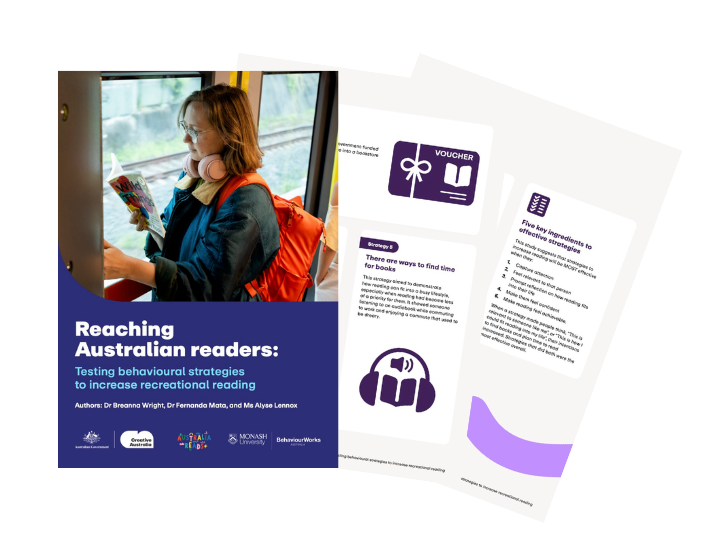
Building on the findings of last year’s Understanding Australian readers report, the new Reaching Australian readers report tests eight behavioural strategies on Australians aged 15+ to discover which were most effective for getting more Australians reading.
The report specifically looked at those that do not read frequently, or actively wish to read more: Engaged, Aspirational, Ambivalent and Lapsed readers.
It also identifies key messaging tactics that should be considered by the sector when implementing reader engagement strategies.
Strategies which feel personally relevant, prompt reflection and promote easy, low-effort approaches are most likely to shift reading intentions.
So whether you’re working at your local public or school library, in a bookshop, or a publishing house, these are some research-backed principles to help get those around us reading.
Start messaging with positive experiences or emotions
Highlight the behaviour you want to see more of – that means embracing messaging that foregrounds the joys and benefits of reading. This is more likely to be effective than messaging that highlights the negative effects of not reading, or puts too much energy and emphasis on problems or other competing forms of leisure – ie screens and technology.
Ensure practical clarity and action
When it comes to reading, people want very clear advice on what to do next and practical tips. Whether you’re promoting a library app or a reading program, make the desired behaviour of your message explicit, simple and immediately doable.
Lead with everyday relevance to strengthen authenticity and realism
People want real and relatable stories of people who have successfully fit reading into their everyday lives. It’s more powerful for shifting behaviour to have messages from trusted people around us than it is to hear aspirational advice from celebrities. When crafting a message, think about the people and communities you’re speaking to and find role models that feel like a good fit for your audience.
Showcase visible diversity of people and book types
People are more likely to respond positively to messaging that feels relevant to ‘someone like them’. Ensure any messaging around reading showcases a diverse range of books (ie genre, audio and ebooks!), readers and communities so that everyone can feel included and excited about reading.
Focus on low-effort options for readers
In our busy lives, people respond best to strategies that feel simple, easy, and low pressure. When trying to promote reading, embrace easy, low-effort ways reading can fit into people’s lives. All reading is good reading, and it can feel gratifying to have someone else validate that for us – or back up our inner voice when it tells us that we don’t need to finish a book we don’t enjoy!
Delve into the full Reaching Australian readers report.