
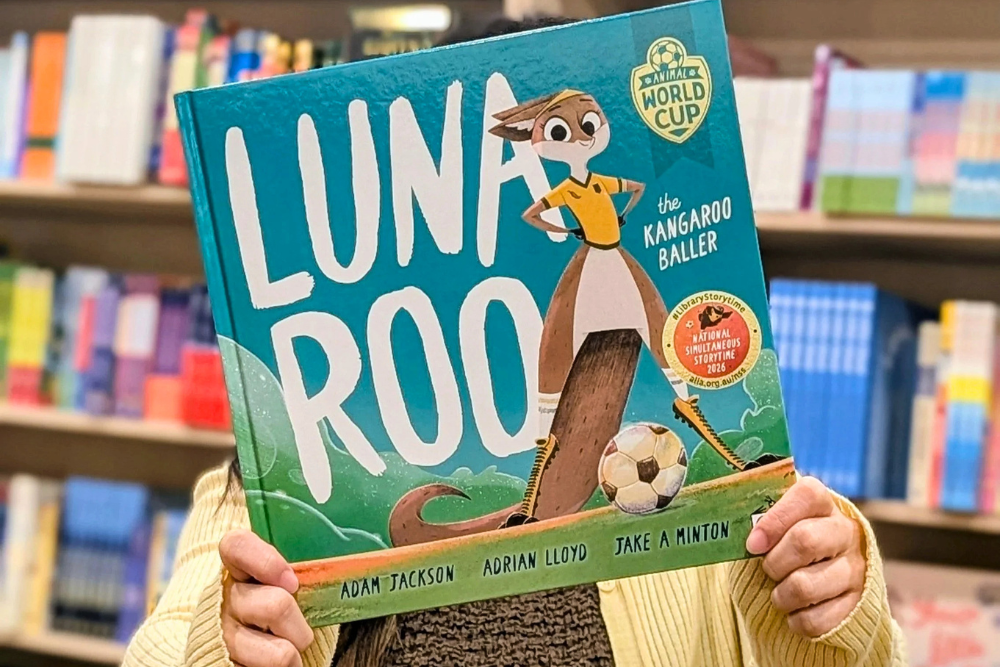
With this year’s National Simultaneous Storytime almost upon us, we catch up with Liz Bradkte from the Australian Library and Information Association to look more closely at the successful shared reading program.
What is National Simultaneous Storytime?
National Simultaneous Storytime (NSS) is an annual nationwide reading event coordinated by the Australian Library and Information Association (ALIA). Each year, a single Australian picture book is read simultaneously in libraries, schools, childcare centres, bookshops, homes and community spaces across the country.
Now in its 26th year, NSS has grown into one of Australia’s largest shared reading experiences, bringing together millions of children, educators, library staff and families in a collective celebration of storytelling, literacy and connection. In 2024, more than 2.3 million participants joined the event across more than 21,000 locations.
At its core, NSS is about creating a joyful national moment around reading — using an Australian story to encourage literacy, imagination and community participation.
At its core, NSS is about creating a joyful national moment around reading — using an Australian story to encourage literacy, imagination and community participation.
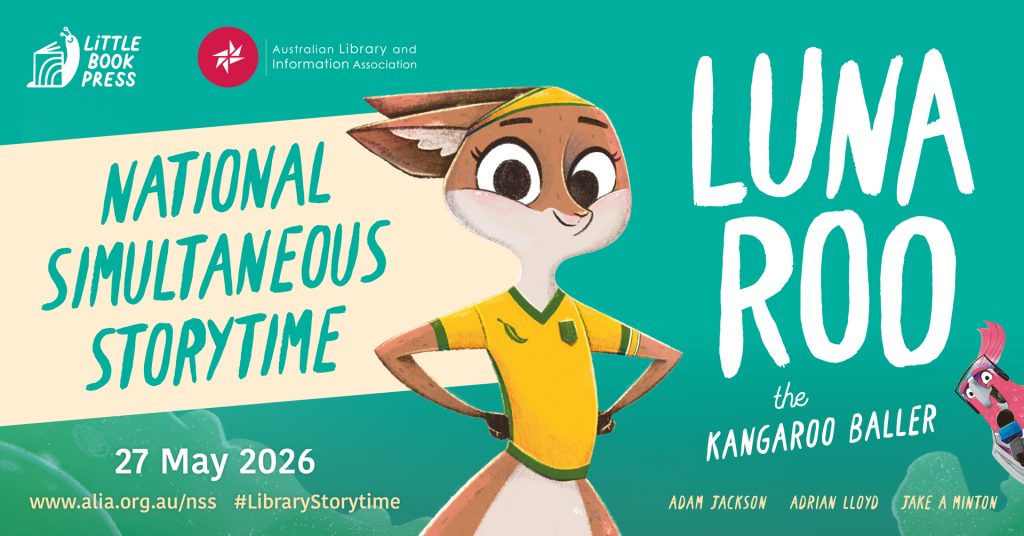
This year, NSS will take place at 12pm AEST on Wednesday 27 May where millions will come together to read Luna Roo: the Kangaroo Baller, written by Adam Jackson and Adrian Lloyd, illustrated by Jake A. Minton and published by Little Book Press.
How does it work?
Each year, publishers from across Australia submit titles for consideration. A judging panel coordinated by ALIA reviews submissions against a range of criteria, including read-aloud suitability, thematic appeal, accessibility, audience engagement and how effectively the book can support educational and creative activities. Practical considerations also play a role, including copyright permissions, large-scale printing capacity and the ability to support translations, performances and resource development.
Once the title is selected, ALIA coordinates a national campaign around the event. This includes registration, promotional materials, teaching and activity resources, merchandise, accessibility supports and partnerships with publishers, educators, literacy organisations and libraries.
Participation is free and intentionally flexible. Some organisations host large-scale community events, while others run intimate storytimes for small groups. The event takes place simultaneously at 12pm AEST on a nominated day in May, creating a shared national reading experience regardless of geography or setting.
The program also relies heavily on partnerships and amplification. Schools, public libraries, early learning centres, publishers, literacy organisations, media outlets and community groups all help extend the reach of the event and adapt it for their audiences. Increasingly, digital delivery has also become part of the model, with prerecorded readings, online resources, livestream-style content and social media engagement helping audiences participate remotely and asynchronously where needed.
Why is it effective?
NSS works because it combines simplicity with scale. The core idea — everyone reading the same book at the same time — is immediately understandable, highly participatory and easy for organisations of all sizes to adopt.
The simultaneity is also important. Reading is often seen as a solitary activity, but NSS reframes it as a collective cultural moment. Children are not simply hearing a story — they are participating in something happening nationally alongside millions of others. That sense of shared experience creates excitement, anticipation and visibility around reading and literacy.
Reading is often seen as a solitary activity, but NSS reframes it as a collective cultural moment.
The program is also effective because it operates through trusted community networks that already exist. Libraries, schools and early learning centres are deeply embedded within communities and already have established relationships with families and educators. NSS provides these organisations with a ready-made framework and practical resources that reduce barriers to participation.
Perhaps most importantly, participation is free! It is free to register for NSS and the broad suite of resources that are developed including classroom activities, craft templates, accessible formats and multilingual or inclusive supports are also free and available to all. This allows organisations to tailor the experience to different ages, settings and community needs while still remaining part of the larger national event.
Finally, NSS succeeds because it centres Australian stories and creators. The event gives national visibility to Australian authors, illustrators and publishers while helping children see their own landscapes, language and experiences reflected in literature.
What are the challenges?
One of the biggest challenges in running a program like NSS is scale. Coordinating a single event across thousands of locations requires significant logistical planning, stakeholder coordination and long lead times. Timelines around book selection, licensing agreements, publisher collaboration, resource development, accessibility production, marketing and distribution all need to align months in advance.
Accessibility and inclusion also require ongoing attention. Ensuring that resources are usable across diverse learning needs, languages, technologies and community contexts is a substantial undertaking, particularly as expectations around accessibility continue to evolve.
Another challenge is sustaining momentum and visibility each year. Because NSS is annual, the program must continually refresh its creative approach, partnerships and promotional activity while still retaining the familiarity that audiences value. Selecting the right book is central to this — it must resonate broadly across age groups, work effectively as a read-aloud experience and lend itself to activities, performances and national engagement.
Finally, programs of this scale rely heavily on collaboration. NSS succeeds because of strong partnerships between ALIA, publishers, libraries, educators, literacy organisations, sponsors and community participants. Coordinating those relationships — while ensuring the program remains accessible, mission-driven and nationally relevant — is both one of its greatest strengths and one of its greatest operational complexities.
Find out more and register for National Simultaneous Storytime today.
ALIA thanks NSS’s partners: Little Book Press, StoryBox Hub, Copyright Agency Reading Australia, Twinkl, Cleverpath, Key Word Sign, Vision Australia, the Museum of Australian Democracy and Dymocks Children’s Charities.